
Summary: FINNO is a cooperation platform (https://www.finnosee.eu/) established by seven Enterprise Europe Network consortia from six neighboring countries (Slovenia, Croatia, Bosnia and Herzegovina, Serbia, Montenegro, North Macedonia). It builds on EEN expertise, services and connections, with Network advisers playing a central role in supporting SMEs, start-ups and scale-ups through investor readiness programmes, business webinars, mentoring, innovation and internationalisation advice, matchmaking and access to cross-border partnerships.
As SMEs face growing pressure to modernise, digitalise and adapt to the green transition, the new EEN–UNIDO Action Plan for 2026–2028 aims to make this cooperation even more practical. Through adviser training, SME diagnostics, transformation plans, pilot activities and cross-border cooperation, EEN, FINNO and UNIDO can help companies access the knowledge, financing opportunities and partnerships they need to become more competitive, resilient and internationally connected.
Why FINNO cooperation matters
FINNO cooperation matters because it is built on the strong foundation of the Enterprise Europe Network, which has been supporting SMEs since 2008. Over nearly two decades, the Enterprise Europe Network has created more than a business support network — it has developed a community of trusted organisations, experienced advisers and innovation experts working together across Europe and beyond.
This long-term cooperation has strengthened innovation support ecosystems, enhanced the capacities of business support organisations and enabled advisers to exchange expertise, good practices and market knowledge.
FINNO takes this collaboration a step further by bringing together seven Enterprise Europe Network consortia from Slovenia, Croatia, Bosnia and Herzegovina, Serbia, Montenegro and North Macedonia. Through joint initiatives, Enterprise Europe Network advisers provide SMEs, start-ups and scale-ups with coordinated support in internationalisation, innovation, digital and green transition, investor readiness and access to finance.
Rather than working in isolation, partners combine their expertise, networks and resources, allowing businesses to benefit from a broader support ecosystem, stronger cross-border partnerships and easier access to European opportunities. Ultimately, FINNO demonstrates that cooperation creates greater impact than individual efforts, helping SMEs become more competitive, resilient and internationally connected.
FINNO: a platform for practical SME, start-up and scale-up support
FINNO was established in 2021 as a cooperation platform of seven Enterprise Europe Network consortia from Slovenia, Croatia, Bosnia and Herzegovina, Serbia, Montenegro, North Macedonia. Its purpose is to strengthen joint work in supporting SMEs, start-ups and scale-ups in preparing for funding, innovation, internationalisation, digitalisation and Sustainability / Green Transition.
Since 2025, FINNO has expanded its activities within the wider Enterprise Europe Network. Its services are structured around three main services:
– FINNO Matchers You
This includes research-to-business, business-to-finance and business-to-business activities, such as the Horizons of Innovation Forum, FINNO Pitching Academia, and matchmaking through SMIC and EEN platforms.
– FINNO Guides You
Through webinars and information sessions, FINNO helps companies better understand business opportunities, investor readiness, EU support instruments and doing business across participating countries.
– FINNO Success Stories
By presenting concrete examples of companies that have benefited from FINNO services, the platform demonstrates how cooperation can lead to practical business outcomes.
FINNO also connects with a wide range of partners and initiatives, including UNIDO, EIT, the Regional Cooperation Council, the European Innovation Council, the European Bank for Reconstruction and Development, CEFTA Secretariat, the Western Balkans Investment Framework and WB6 Chamber Investment Forum.
Joint Initiative by FINNO and the EEN Thematic Group Start-up and Scale-up
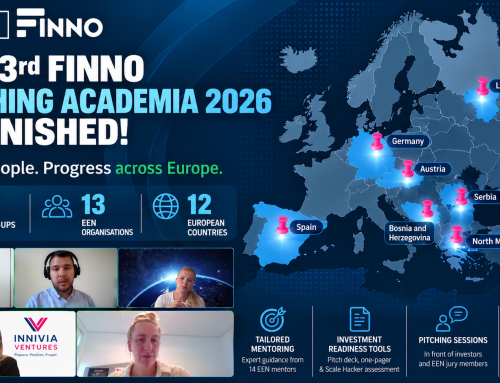
One of the concrete examples of FINNO cooperation is the 3rd FINNO Pitching Academia, organised together with the EEN Thematic Group Start-up and Scale-up. The programme is designed for start-ups preparing to approach investors and will run as a one-month online mentoring programme from 7 to 30 September 2026.
The programme offers start-ups practical support in checking their investment readiness, preparing a one-pager for potential investors, improving their pitch deck, receiving mentor support and pitching in front of investors. Participants also benefit from promotion through LinkedIn and the FINNO platform.
FINNO and the EEN Thematic Group Start-up and Scale-up provide a pool of mentors who support start-ups and scale-ups in conducting assessments, preparing investor materials and polishing their pitch decks for pre-seed and seed investors. The FINNO Pitching Academia will also be delivered as one of the supporting activities in the pilot programme under EEN–EIT cooperation.
Helping SMEs move from ambition to implementation
SMEs face several interconnected challenges when trying to modernise, digitalise and become more competitive. These include limited access to advanced technologies, insufficient digital skills, lack of strategic knowledge on Industry 4.0 implementation, and difficulties in accessing finance for innovation.
Recent data underline why SME support is central to FINNO, EEN and UNIDO cooperation in Slovenia, Croatia, Bosnia and Herzegovina, Serbia, Montenegro and North Macedonia. In the EU, SMEs represent 99.8% of all enterprises, almost two-thirds of employment and slightly over half of value added, confirming their central role in economies such as Slovenia and Croatia. In Bosnia and Herzegovina, North Macedonia, Serbia and Montenegro, SMEs also represent a major part of employment and value creation.
UNIDO’s study Industry 4.0 readiness assessment in the Western Balkans confirms that the main constraints faced by SMEs are financial and human rather than attitudinal. Budget is the single most significant barrier, cited by 71% of surveyed firms, followed by a skills gap reported by nearly six in ten companies.
This reveals an important paradox: many firms are open to Industry 4.0 and consider themselves able to adapt, yet fewer than one in ten have a defined vision or documented roadmap. In other words, openness to transformation has not yet translated into structured planning, and investment therefore often remains reactive.
The capability base is also limited. Seven in ten firms have none of the specialist in-house roles required for digital transition, 85% have no defined career path for such roles, and eight in ten conducted no upskilling activities in the past year. This does not reflect a lack of ambition. It reflects a lack of structure, practical guidance and implementation capacity — precisely the gaps that targeted advisory support, SME diagnostics, transformation planning and cross-border cooperation can help address.
Why cooperation creates stronger SME support
Manufacturing challenges and opportunities do not stop at national borders. A cross-border approach allows firms to draw on a wider pool of expertise, technology providers and partners than any single national market could offer.
The study also points to a structural gap in how support reaches enterprises: 61% of companies are unaware of any public support measure, and seven in ten have not used any in the past three years. Support is often designed at a broad national level, while the specialised, firm-facing intermediation needed to carry it to individual enterprises remains limited.
This is the gap the cooperation between EEN, FINNO and UNIDO is designed to close. It connects trusted advisers, practical methodologies, technology providers and support mechanisms, helping firms access the knowledge and tools they need to act.
Through the Enterprise Europe Network and FINNO, companies can connect with advisers, researchers, investors, technology providers and innovation support organisations across borders. This helps create stronger value chains, facilitates business partnerships and accelerates the exchange of good practices in innovation, digital transformation and green transition.
How EEN and UNIDO turn complex topics into concrete business steps
The EEN–UNIDO Action Plan focuses on Industry 4.0, green transition and digital transformation with the aim of helping SMEs become more productive, resilient and sustainable. In practical terms, this means supporting companies in adopting smart manufacturing technologies, digital tools, AI, data analytics and connected production systems.
The goal is not technology for its own sake, but improved operational efficiency, reduced costs, better decision-making and stronger competitiveness in international markets.
A key part of this cooperation is UNIDO’s project Fostering Industry 4.0 for green transition and circular economy in the Western Balkans, financed by Slovenia and Cyprus. Under this project, UNIDO carried out the Industry 4.0 readiness assessment, developed the custom Factory of the Future methodology and established the Smart Manufacturing Innovation Centre in Novi Sad.
Building on this, UNIDO and SMIC will train and certify a common pool of EEN advisers to a shared standard. This means that companies can access the same quality of diagnosis, while identified business needs can be matched with suitable technology and service providers across borders.
Rather than functioning as a conventional maturity assessment, the Factory of the Future methodology begins by identifying the operational challenges and costs faced by the enterprise. A certified adviser conducts the diagnosis on site, maps the firm’s operational losses and translates them into a concise, costed transformation plan. This gives the company a practical roadmap — something that many firms currently lack.
The role of Network advisers
Network advisers play a key role in translating complex topics such as Industry 4.0 and digital transformation into concrete business actions.
Through webinars, one-to-one consultations, mentoring and practical case studies, advisers help SMEs assess their readiness, identify priorities, avoid common implementation mistakes and develop realistic digital transformation roadmaps.
Their role is not only to explain digital transformation, but to translate a company’s general intention to modernise into a concrete first step. They connect companies with finance, training, technology providers and other relevant support services. Rather than focusing on technology alone, advisers help companies apply innovation where it creates measurable business value.
The experience reflected in FINNO activities shows that SMEs need an integrated support approach. Awareness remains important, but companies increasingly require practical technical expertise, personalised advisory services, transformation planning, access to investors and financing opportunities, and connections with business and innovation partners.
Network advisers have a key role in translating complex topics such as Industry 4.0 and digital transformation into concrete business actions. Through webinars, one-to-one consultations, mentoring and practical case studies, advisers help SMEs assess their readiness, identify priorities, avoid common implementation mistakes and develop realistic digital transformation roadmaps.
Rather than focusing on technology alone, advisers support companies in applying innovation where it creates measurable business value.
FINNO activities show the need for hands-on support
Planned and ongoing FINNO activities, such as FINNO Pitching Academia, “FINNO Guides You” webinars and cooperation with the EEN Thematic Group Start-up and Scale-up, show that SMEs and start-ups are looking for practical, hands-on support rather than theoretical training.
They need help in preparing investment-ready business pitches, improving presentation skills, receiving personalised mentoring, understanding digital transformation and connecting with investors and international partners. The strong emphasis on coaching, individual feedback and practical tools reflects the growing demand for tailored business development support.
A concrete example is FINNO Pitching Academia, which brings together start-ups and innovative SMEs. Participants receive training on developing investor-ready pitch decks, personalised mentoring from Enterprise Europe Network advisers, live pitching practice and continued support after the programme.
This initiative demonstrates how cooperation can combine expertise from multiple partners to help companies improve investment readiness and connect with wider international business and investor networks.
How the Enterprise Europe Network and UNIDO are strengthening SME support across the Western Balkans
UNIDO’s study “Industry 4.0 readiness assessment in the Western Balkans”, confirms that the main constraints faced by SMEs are financial and human rather than attitudinal. Budget is the single most significant barrier, cited by 71% of the surveyed firms, followed by a skills gap at nearly six in ten. Beneath this lies an important paradox: firms are broadly open to Industry 4.0 and consider themselves able to adapt to it, yet fewer than one in ten have a defined vision or a documented roadmap. That openness has not yet translated into a plan, and investment therefore tends to remain reactive. The capability base is similarly limited: seven in ten firms have none of the specialist in-house roles a digital transition requires, 85% have no defined career path for such roles, and eight in ten conducted no upskilling activities in the past year, with the workforce concentrated at beginner level across all technical domains. None of this reflects a lack of ambition; it reflects a lack of structure, which is precisely what the right support can address.
Because manufacturing challenges and opportunities do not stop at national borders, a cross-border approach lets firms draw on a wider pool of expertise, technology providers and partners than a single national market can offer. The study points to a structural gap in how support reaches enterprises: 61% of companies are unaware of any public support measure, and seven in ten have not used any in the past three years. Support is often designed at a broad, national level, while the specialised, firm-facing intermediation needed to carry it to individual enterprises remains limited. This is the gap the cooperation is designed to close. It sits under UNIDO’s project “Fostering Industry 4.0 for green transition and circular economy in the Western Balkans”, financed by Slovenia and Cyprus, under which UNIDO carried out the regional study behind these findings, developed the custom Factory of the Future methodology, and established a hub, the Smart Manufacturing Innovation Centre (SMIC) in Novi Sad. Building on this, UNIDO and SMIC will train and certify a common pool of EEN advisers to a single standard, so that a firm in any of the economies can access the same quality of diagnosis. In addition, a regional CRM platform brings certified advisers, firms, and technology and service providers together in one system, ensuring that a need identified on one shop floor can be matched with a suitable provider across borders rather than remaining unmet.
In practical terms, the cooperation should help firms move beyond the pattern the data captures most clearly: the gap between intention and action. Firms are open to a range of Industry 4.0 tools, yet adoption of more advanced technologies, such as digital twins, augmented and virtual reality, or additive manufacturing, remains below one in ten, and where technology has been adopted the most frequently reported impact is still “no change”. Interest alone does not deliver transformation. The response to this is the custom Factory of the Future methodology, which UNIDO developed for precisely the firm profile the study describes: owner-managed, capital-constrained and limited in specialist skills. Rather than functioning as a conventional maturity assessment, the methodology begins by identifying the operational challenges and costs faced by the enterprise, rather than simply measuring its level of digitalisation. A certified adviser conducts the diagnosis on site, maps the firm’s annual operational losses, and converts them into a concise, costed transformation plan, the roadmap that fewer than one in ten firms currently have, with the green transition integrated into the same diagnosis rather than added separately, given that only 15% of firms currently have a digitally supported environmental strategy.
The study is particularly clear, as firms were asked directly. Advisory services and investment subsidies rank jointly first, each cited by 62% of firms, followed by skills support at 61% and access to finance at 57%. Firms are calling for structured advice, capability-building and financing in almost equal measure, which provides a strong basis for the advisory-led model at the centre of this cooperation. One distinction is worth emphasising: the missing element is not awareness of the need, since firms are already open to change, but awareness of the support that exists. When nearly half of the firms that used no support indicate that they were simply unaware of it, the appropriate response is not a further general awareness campaign, but a trusted adviser working directly with the firm to connect it to the finance and the providers that already exist but have not yet reached it.
The Network advisers are where this complexity is translated into practice, and they do so by avoiding the abstract discussion altogether. Given a firm base that is open but under-planned, under-skilled and under-informed, abstract explanations of Industry 4.0 have little effect on a shop floor operating under budget pressure. This is why UNIDO and SMIC train and certify the EEN advisers together on the shared methodology: it places a common, quality-assured standard behind every engagement, wherever in the region it takes place. In practice, the adviser works alongside operators on site, anchors each observation to something measurable, expresses it as a figure that is already meaningful to the owner, and only then introduces technology, as the response to a specific, costed problem. And because the principal barrier is that firms are unaware of what is available, the adviser also performs a second essential function: translating a general intention to modernise into a concrete first step, and using the platform to connect the firm with the funding, training or provider it did not know it could access.
What success could look like by 2028
By 2028, the goal is to see more SMEs successfully implementing digital technologies, participating in international markets, attracting investment and collaborating across borders. These initiatives should contribute to stronger innovation capacity, better integration into European value chains and greater resilience through sustainable and digitally enabled business models.
Success should also be visible beyond formal indicators. It would mean stronger trust and collaboration among SMEs, greater willingness to invest in innovation, wider adoption of digital solutions and more frequent business partnerships.
Ultimately, success would mean that companies increasingly see cooperation, shared expertise and international networks as a natural part of their business development and growth.